Summary
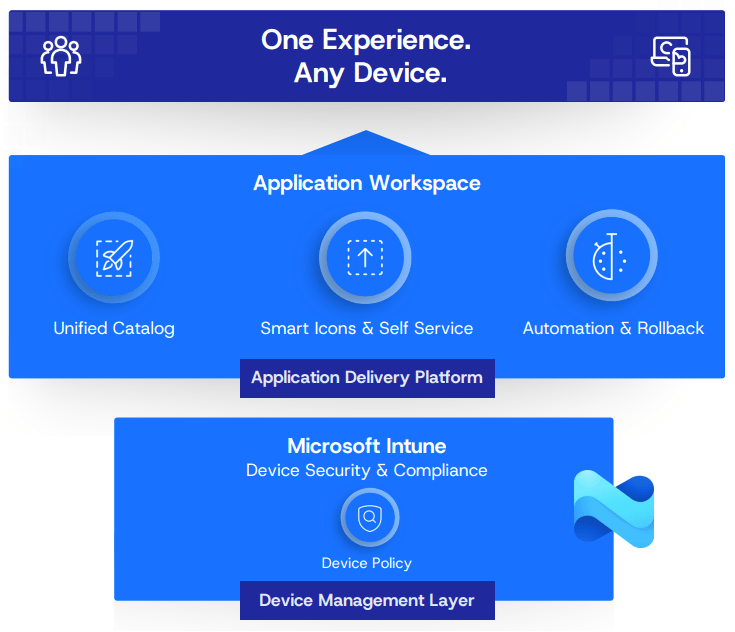
Application Workspace by Recast Software works alongside Microsoft Intune to elevate application delivery, automation, and user experience. Intune is Microsoft’s cloud-based endpoint management service (MDM/MAM) and, for many organizations, the modern successor to purely on‑premises tools like Configuration Manager. It excels at device enrollment, security, and compliance.
Application Workspace focuses on application delivery and management. It aggregates apps from every source, automates delivery and updates, and gives users a consistent, intuitive way to get the software they need. The sections below highlight how Application Workspace complements and amplifies Intune’s capabilities.
How Application Workspace complements Microsoft Intune
Break the never-ending patching cycle
- Intune manages device compliance and can deploy applications. Application Workspace sits alongside Intune as the application solution that aggregates apps from Intune, ConfigMgr, VDI (Citrix, VMware, AVD, Windows 365), and SaaS into a single workspace.
- End users see one catalog and one set of Smart Icons for every app, regardless of where it’s hosted, which simplifies access and reduces confusion.
- The largest curated catalog of off-the-shelf applications keeps third-party apps continuously packaged, updated, and ready for users. Trigger-based updates run through login, logoff, session lock/unlock, refresh, and other events, helping IT avoid overnight maintenance window bottlenecks.
Advanced automation and customization
- Application Workspace adds policy‑driven workflows for installation, updates, and uninstalls. Admins can use rich conditions and triggers (user, group, device type, location, network, time) to decide when and how apps are delivered.
- Visual, task‑sequence‑style packaging lets you define pre‑ and post‑install actions (registry edits, service changes, user prompts, scripts) without building complex wrapper scripts. The same package can be reused across Intune, ConfigMgr, AVD, Windows 365, and Citrix, so you package once and deliver everywhere.
- Customers have cut packaging and rollout time by 80–90%, taking work that once took most of a day down to under an hour.
Package once, deliver everywhere
The pain is not one big event. It is repeated small friction across the user lifecycle.
Stage 1
Define once in Application Workspace
Create a single reusable package for any app type, script, or link.
Stage 2
Publish Smart Icons across workspaces
Assign context rules (identity, device, network) so the right app appears in the right place, automatically.
Stage 3
Just-in-time delivery to devices
Installs execute immediately based on triggers (e.g., user login, user launches app).
Stage 4
Measure and improve
Gain real-time visibility into install health, launch success, and version compliance across all endpoints.
Intune + Application Workspace = one app model, many workspaces, less rework
Hybrid environment support
- Intune is optimized for cloud‑managed devices. Application Workspace unifies application management by spanning cloud, on‑premises, and virtual environments without replacing your existing tools.
- A lightweight Application Workspace agent serves as the delivery path and can be used with Intune, ConfigMgr, AVD, Windows 365, VMware Horizon, Citrix, or local content. The user experience stays the same even when the back end changes, letting you move device management into Intune at your own pace.
Device onboarding and context‑aware user experience
- Application Workspace enables context‑aware application delivery: rules based on identity, device type, network, location, or tenant decide which apps and settings a user receives.
- These contexts streamline onboarding. Autopilot or Intune applies a light, agent-only image, while Application Workspace pulls in the right apps per user and keeps them updated.
- A modern self‑service portal and Workspace launcher give users one place to install approved apps and launch every resource (local, web, streamed, or VDI) with a single Smart Icon—reducing “please install X” tickets and helping users stay productive.
Improved application lifecycle management
- Application Workspace adds greater functionality for managing the lifecycle of applications, from packaging to deployment and patching.
- Rollback and version pinning allow you to quickly revert to a previous version if an issue appears, stabilizing the environment while IT investigates.
- When a cloud delivery attempt fails (for example, an Intune deployment impacted by network conditions), Application Workspace can fall back to alternate delivery paths such as on‑premises content or local caches to keep installs moving.
Application integration and packaging
- Application Workspace simplifies packaging by supporting native formats—MSI, Win32, MSIX, App‑V, macOS packages, scripts, and SaaS URLs—and wrapping them in a single, reusable package.
- Instead of creating a separate Intune Win32 app for every variation, you can often upload the original installer once and manage context, targeting, and settings in Application Workspace, dramatically reducing packaging effort.
- Context‑aware packaging means the same definition can install locally on a laptop, stream from AVD, or launch as a Citrix app depending on the user’s context. No duplicate packaging required for each workspace.
Better versioning, control, and audit
- Application Workspace makes it easy to roll out new versions to pilot rings, expand to early adopters, and then move to broad production while keeping a clear view of which versions run where.
- Every package change is tracked as it moves through DTAP: who changed it, what changed, and why. Previous versions are automatically archived, so you can roll back with full audit history, critical for regulated environments and internal reviews.
Application visibility and insights
- Compared to Intune’s basic success/failure views, Application Workspace offers deeper visibility into application usage and health: who has which apps, where they are launched, install success/failure, and detailed error information across physical and virtual endpoints.
- New near real‑time reporting, delivered via an OData API, provides event‑level data, including deployments, launches, install health, license usage, and more. You can monitor trends, validate compliance, reclaim under‑used licenses, and export data into existing SIEM and reporting tools.
Application cost and efficiency gains
- By centralizing packaging, patching, and self‑service across Intune and the rest of your estate, Application Workspace reduces repetitive work and after‑hours “fire drills” for updates. Customers have reported up to 90% reductions in time spent configuring, deploying, and updating applications.
- Because you can often upload the original source instead of creating a separate Win32 app per application in Intune, packaging queues shrink and the same team can support more apps without additional headcount.
Summary: How Application Workspace improves Microsoft Intune
Recast Software’s Application Workspace doesn’t replace Intune or sit inside it as a plug-in. Intune remains your control plane for devices, compliance, and security policies. Application Workspace adds a dedicated application solution on top, with its own automation engine.
Together, they give you:
- Stronger control over how applications are packaged, tested, delivered, and patched across hybrid environments.
- A unified experience for users, who get one catalog and one way to launch every app, regardless of where it lives.