Introduction and executive overview
Between January and June 2026, Recast surveyed over 100 IT professionals at European community and industry events. Respondents were the people who own the daily aspects of application management: sysadmins, endpoint engineers, packagers, architects, and IT managers.
The picture that emerges is practical, not futuristic. Teams are not describing a market waiting for another transformation slogan. They are describing the daily work of delivering applications across laptops, virtual desktops, Cloud PCs, and hybrid environments while proving that those applications are available, current, and compliant.
The three main findings
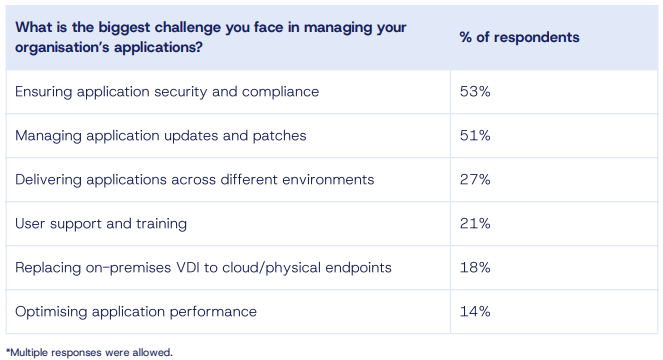
- Security and patching are the biggest pressure points. 53% mention application security and compliance, and 51% mention updates and patches. This opens the door to a wider conversation about application readiness, visibility, and governance.
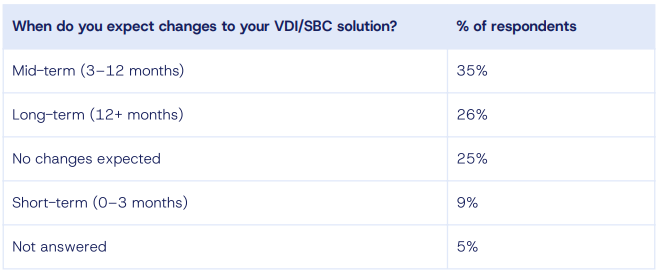
- VDI and SBC are being reshaped, not switched off. 44% expect change within the next 12 months, and 70% expect change over a defined timeframe. Europe is modernising these environments, not retiring them.
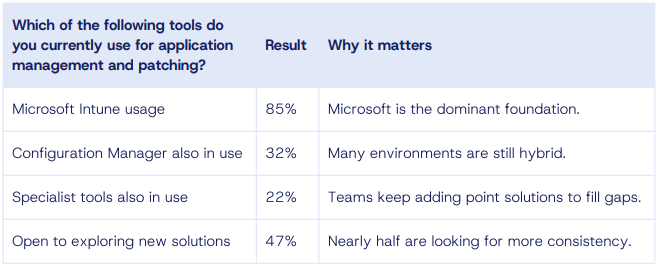
- Microsoft is the foundation, but the experience remains fragmented. 85% use Microsoft Intune, often alongside Configuration Manager and specialist tools. With 47% open to new solutions, the opportunity is to give IT a more consistent model and users a simpler workspace experience.
Application management needs consistency
The most important message in the data is not that European IT teams need another patching product. Patching is simply where the pain becomes visible first. The deeper challenge is that application inventory, delivery logic, update status, vulnerability context, user access, and reporting often live in separate places.
Security and patching open the door, but the bigger conversation is application readiness across every workspace.
Security and patching are where the issue shows up first. 53% of respondents mention application security and compliance as a top challenge, and 51% refer to managing updates and patches. The wider issue is application readiness: knowing which applications are current, available, secure, and governed across physical, virtual, and cloud workspaces.
The question is not just whether applications are patched. It is whether IT can keep them current, secure, and compliant as requirements change across different workspaces.
Finding 1
Security and patching are the biggest pressure points
Security and patching dominate the survey because they are where application management becomes measurable. A missing update becomes a vulnerability. A vulnerable application becomes an audit finding. But these pressure points are an opportunity for IT organisations to take a closer look at their broader application management approach.
These are not two separate problems being solved by two separate teams. Security and patching were the most frequently co-selected pair of answers. A team that worries about compliance also worries about whether last week’s CVE has actually been closed on every endpoint. A team that worries about patching knows unpatched applications are the biggest single reason auditors, insurers, and CISOs come knocking.
Finding 2
VDI and SBC are being reshaped, not switched off
Recast’s 2026 global VDI report found that only 2% of organisations plan to exit VDI entirely, while 49% have made a significant change in the last two years. The European data tells the same story: change is expected but on a modernisation curve, not an exit curve.
44% of respondents expect a change to their VDI or SBC environment within 12 months, and 70% expect change within a defined timeframe. The signal is not that VDI is disappearing. It is that organisations are reworking how applications move across physical endpoints, virtual desktops, AVD, and Windows 365.
In the European market, this shift is also being accelerated by organisations reassessing longstanding workspace tooling, including companies moving away from Ivanti Workspace Control. For these teams, the question is not simply what replaces that solution. It is an opportunity to rethink their modern workspace strategy.
Finding 3
Microsoft is the foundation, but the experience remains fragmented
When we asked which tools respondents currently use for application management and patching, one answer dominated: Intune. But it exists alongside other environments, and that combination is where the operational pain lives.
85% of respondents use Microsoft Intune, often alongside Configuration Manager and specialist tools for third-party patching, macOS delivery, workspace personalisation, or vulnerability response. Those tools may solve important parts of the workflow. The gap is that application inventory, delivery logic, update status, access, and reporting often live in separate places.
The data shows a Microsoft-first market, not a Microsoft-only one. Intune is widely used, but Configuration Manager and specialist tools remain part of the stack. With 47% open to exploring new solutions, the opportunity is to help teams move from fragmented tooling to a more consistent application management model.
The open-text responses to the question about missing capabilities in current application management solutions show a clear pattern. Respondents asked for a single overview, one place to rule them all: client dashboarding, better reporting, reusable automation, and cross-environment visibility in one view. These are not requests for another point solution. They are requests for one reliable view across the tools, platforms, and environments already in place.
Finding 4
Nearly half the market is open to a better model
24% of respondents describe themselves as neutral or satisfied with their current application management approach. 47% are actively open to exploring something new, and 14% have requested an Application Workspace demo to actively evaluate the alternative. That does not mean the market needs to be convinced there is a problem. It means the market already feels the friction and is open to a better model.
What IT leaders should do differently
The practical takeaway is simple: address patching and security as one aspect of the larger challenge of application management. The goal is not to add one more console. It is to bring together the environments and tools IT already runs.
Three recommendations
- Measure application readiness, not just patch completion. Ask whether every required application is available, current, secure, and compliant across each workspace type: physical endpoint, VDI, AVD, Windows 365, and cloud managed.
- Simplify the user workspace experience. VDI, Cloud PC, and physical endpoints will continue to coexist, but users should not have to think about where an application is delivered from. New investments should be judged on whether they give users one consistent way to access the applications they need across every workspace.
- Build an accurate application data foundation before automating the workflow. Automation only works when the underlying application data is accurate, complete, and trusted. Establish a reliable view of application ownership, access, lifecycle status, and readiness first. Then automate around it.
How Application Workspace fits
Application Workspace is Recast’s technology-agnostic, end-to-end application management platform for managing, delivering, and governing applications. Rather than requiring a rip-and-replace approach, Application Workspace brings together technologies such as Microsoft Intune, Configuration Manager, Citrix, Omnissa, AVD, and Windows 365 into a single, unified application experience. Acting as the operational layer across the modern workplace, it enables organisations to manage application delivery consistently while giving end users one seamless way to access the applications they need, regardless of the underlying platform.
Methodology
This report is based on more than 100 completed responses Recast gathered between 1 January and 30 June 2026 at eight European community and industry events. Respondents were IT professionals with day-to-day responsibility for application delivery, patching, endpoint management, or IT architecture. Data was collected on paper forms and through an online survey run at each event.