Why Modern IT Teams Add Application Workspace to Their Stack
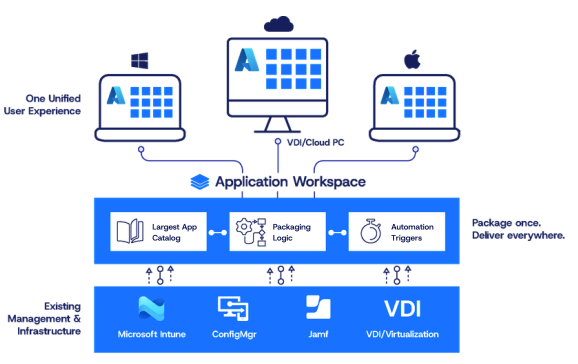
Application Workspace gives IT a single place to deliver, update, and govern applications across Windows, macOS, and virtual desktops. It enhances tools like Intune, Jamf, and Workspace ONE instead of ripping them out.
With Application Workspace, teams:
- Deliver all apps through one user-friendly workspace
- Shorten device onboarding and rebuilds from hours to minutes
- Keep thousands of third-party apps current with less manual work
- Gain application-level insight leadership can trust
Unify how people find software and use devices
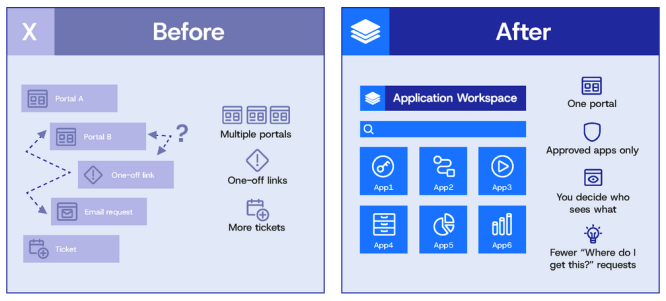
Employees often have to bounce between multiple portals and one-off links to get the apps they need. It’s confusing, increases help desk tickets, and creates noise for IT.
One place to find approved software
Application Workspace provides a single, intuitive portal for all approved applications across Windows and macOS, with the same experience whether users are on a laptop, Cloud PC, or VDI session. You decide who sees what. They get one place to find their software.
The result: fewer “Where do I get this app?” tickets, higher self-service adoption, and a consistent software experience for every employee.
Onboard or restore people, not just devices
Rebuilding a device or shipping a new PC often forces users to start from scratch: hunting down apps, recreating preferences, and losing an afternoon (or more) of productivity.
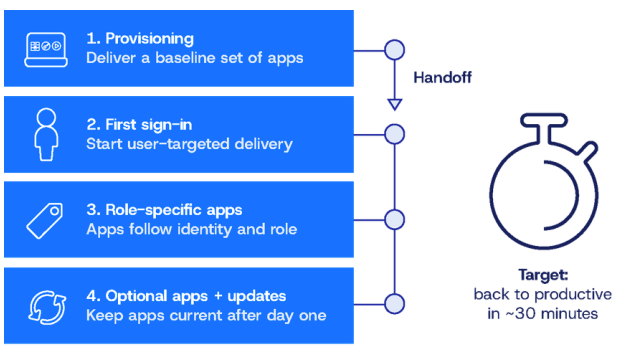
With Application Workspace, you can use context to deliver a baseline during provisioning, then add user-specific apps at first sign-in across macOS, Windows, and virtual desktops. The same user-friendly governance then continues for any optional software and updates.
You get closer to a 30-minute “back to productive” target instead of a half-day (or more) reinstall marathon.
From rebuild to productive, faster
Same approach across Windows, macOS, and virtual desktops
Run app deployment at scale
IT teams often juggle software libraries containing hundreds to thousands of applications, multiple OSs, and strict change or maintenance windows. This makes DTAP flows and ring-based rollouts harder to manage, especially when you’re just trying to keep everything organized.
Application Workspace gives you:
- Clear promotion staging through Dev, Test, Acceptance, and Production stages
- Ring-based deployments (Canary, Early, Broad) driven by tags and context
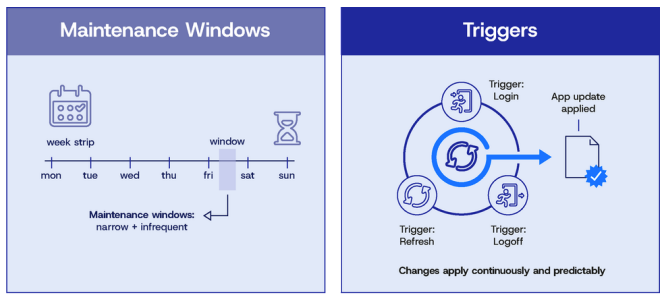
- Trigger-based delivery (login, logoff, refresh, and more) so changes and updates happen continuously and predictably, without relying on narrow maintenance windows
- Visual packaging lets admins design complex logic in a task-sequence-style editor without resorting to wrapper scripts.
You orchestrate complex deployments with less manual sequencing, fewer failed changes, and more predictable rollouts.
Continuous delivery without maintenance-window drama
Stay current with curated automatic updates
Manually updating hundreds or thousands of apps isn’t sustainable. Teams burn valuable cycles repackaging, testing, and chasing down vulnerable or missed software versions.
Application Workspace ships with a curated third-party application catalog and evergreen updates. With Application Workspace, common enterprise apps stay current automatically while carrying your customizations forward across versions—without breaking every time a vendor ships a new build.
You close security gaps faster, reduce patching backlog, and give security teams confidence that third-party software isn’t your weakest link.
Get the reporting and insight leadership expects
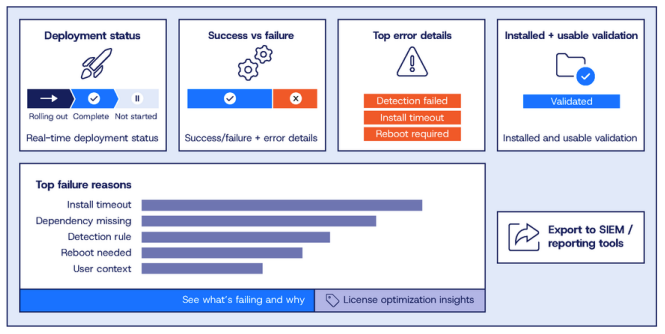
Leadership wants clear answers: Did the rollout work? Where are we exposed? Are we over-licensed? Native tools often only show basic success/failure states without real context.
Application Workspace gives application-level visibility, including:
- Real-time deployment status, success/failure, and error details
- Validation that applications are actually installed and usable
- Data to support license optimization and reclamation
Answer “Are we healthy?” in minutes
You can export data to your SIEM and reporting tools or use built-in views.
Be ready for scale: Multi-tenant and M&A realities
Mergers, acquisitions, and regional business units often leave you with multiple tenants and fragmented environments.
Application Workspace is built to operate across multiple tenants while preserving separation and control. You can:
- Share a standardized catalog and policies across tenants without maintaining duplicates
- Keep entitlement, reporting, and governance clearly segmented
- Bring new business units into a consistent application experience without rebuilding everything from scratch
This turns M&A from “another round of app chaos” into a repeatable playbook.
Add Application Workspace now
Modern IT teams are under pressure to:
- Deliver a unified, clean software experience
- Accelerate Intune adoption without breaking what works today
- Shrink manual effort for device onboarding, rebuilds, packaging, patching, and approvals
- Prove value with clear reporting and lower total cost of ownership
Application Workspace sits alongside your existing endpoint management tools to elevate application delivery, automation, and user experience. You can make the modern workplace work better, faster, and with far less friction.
Next step: Share this one-pager with stakeholders and compare it against your current app
delivery reality. If these pain points look familiar, Application Workspace should be on your short
list.