




For years, the endpoint management story seemed straightforward. Organizations would move from Microsoft ConfigMgr to Intune, shift workloads to the cloud, and eventually retire legacy infrastructure. While most IT teams understood the transition would take time, the assumption was that the destination was clear: a fully cloud-managed future.
But that’s not how things have played out according to the State of Intune in 2026 survey results.
This research finds many organizations operating in what can best be described as the “messy middle.” And it’s not a temporary phase. Today’s teams are managing devices across both ConfigMgr and Intune, balancing modernization efforts with long-established operational requirements, and supporting users across increasingly complex environments.
The migration everyone expected
ConfigMgr has been a cornerstone of endpoint management for decades. As Microsoft’s cloud strategy evolved, Intune became the centerpiece of modern management initiatives, giving organizations a path toward cloud-based administration and device management.
The expectation was simple: Workloads would gradually move from ConfigMgr to Intune until organizations became fully cloud managed. The phrase “migrating to Intune” became synonymous with modernization.
However, many organizations discovered that migration wasn’t a project with a clean finish line. Workloads moved at different speeds, business requirements varied across teams, and long-established processes continued to depend on ConfigMgr. Instead of replacing one platform with another, many organizations found themselves adding Intune while continuing to rely on the systems and workflows already in place.
Over time, modernization became less about a destination and more about learning how both platforms could coexist while organizations continued moving forward.
The messy middle nobody planned for
As organizations adopted Intune, many discovered the transition introduced new challenges rather than eliminating old ones.
Reporting, inventory, and compliance information often became distributed across multiple systems. Application packaging, deployment, and patching workflows stretched across different tools. Visibility became harder to maintain, and IT teams were expected to modernize without disrupting daily operations.
The assumption was that co-management would be short lived. For many teams, it has become the way they work.
Even as workloads move to Intune, core responsibilities remain unchanged. Applications still need to be deployed. Devices still need to be managed. Users still need support. Security policies still need to be enforced. Introducing Intune doesn’t eliminate those responsibilities. It simply changes where and how they’re managed.
The State of Intune in 2026 survey results confirm the hybrid reality
The survey data reinforces just how widespread the Microsoft messy middle has become.
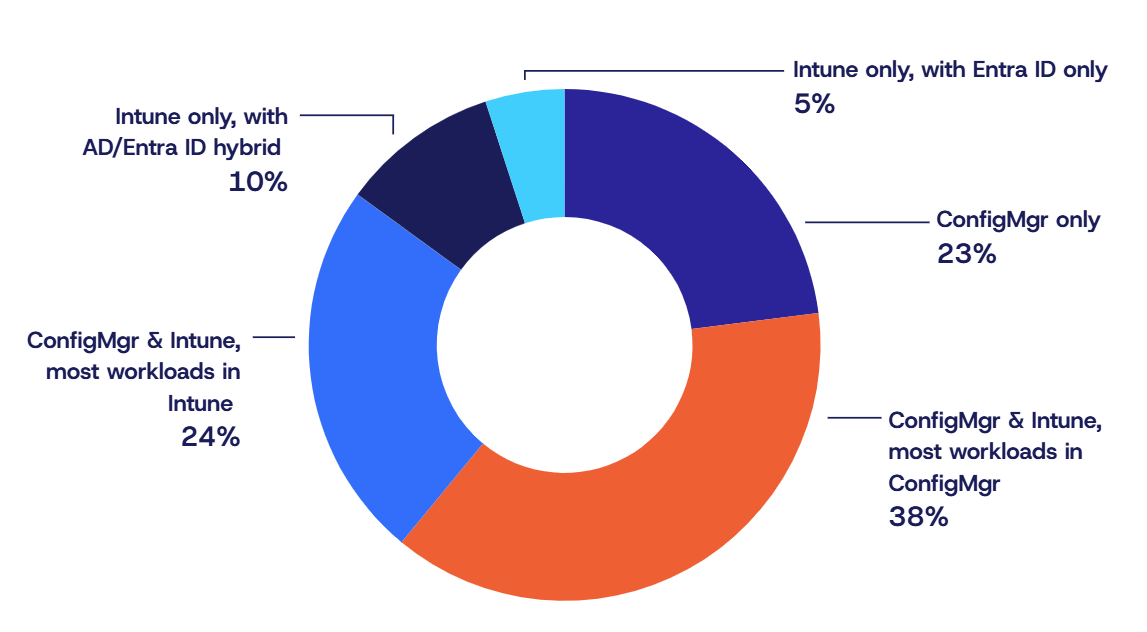
Among the 890 IT professionals surveyed, 62% reported managing devices with both ConfigMgr and Intune. The survey also found that 55% of organizations using ConfigMgr have either no plans to retire it or no timeline for doing so. That’s a significant finding because it challenges the assumption that every organization is working toward an Intune-only future.
The operational challenges keeping teams stuck in the messy middle
One of the most important findings from the survey is that the biggest challenges aren’t migration activities themselves. They’re the everyday tasks that continue before, during, and after migration.
Application packaging and deployment ranked as a top challenge cited for 37% of respondents. Third-party patching, troubleshooting, Windows Update management, and reporting followed closely behind. These aren’t one-time migration hurdles. They’re recurring responsibilities that consume valuable time every week.
Why the right operational layer matters
The survey findings point to a broader reality: Endpoint management today is less about choosing a platform and more about maintaining operational consistency.
Many IT teams manage environments where ConfigMgr and Intune coexist. Devices, applications, policies, reporting workflows, and support processes span multiple systems. Success depends on creating a consistent IT and end-user experience despite that complexity.
That’s why the concept of an operational layer has become increasingly important. Organizations need ways to maintain visibility, reduce console switching, simplify administration, and support users regardless of where workloads are managed. During a transition that may last years rather than months, consistency often matters more than platform purity.
Recast is the companion that helps organizations go deeper, move faster, and operate more effectively alongside Microsoft Intune and ConfigMgr. From application delivery and user experience to analytics, patching, and privilege control, Recast enables IT teams to navigate the Microsoft messy middle with effective solutions: Application Workspace for application management and Right Click Tools, with modules for Patching, Insights, and Privileged Access, for critical aspects of endpoint management.
Conclusion
The endpoint management journey hasn’t followed the path many expected. Rather than progressing directly from ConfigMgr to Intune, most organizations have landed somewhere in between. The State of Intune in 2026 report shows that hybrid management remains the dominant model, ConfigMgr continues to play a critical role, and operational challenges persist long after cloud adoption begins.
The messy middle isn’t just a transition phase. For many organizations, it’s become a long-term operating model. The teams that succeed won’t necessarily be the ones that move the fastest. They’ll be the ones that find effective ways to manage complexity while supporting users, securing devices, and keeping everyday operations running smoothly.