




Microsoft Intune continues to gain traction as organizations modernize endpoint management, strengthen security, and support increasingly distributed workforces. But as the findings from Recast’s State of Intune in 2026 survey show, adoption doesn’t automatically translate into operational simplicity.
The survey gathered responses from 890 IT professionals and uncovered a clear theme: Many teams still spend significant time on manual, repetitive work even though they generally have a positive view of Intune. The result is a platform that organizations value, paired with operational realities that continue to challenge even experienced administrators.
Intune’s strengths drive adoption
Despite the challenges highlighted throughout the survey, IT professionals overwhelmingly see value in Intune, whether they use Intune alone or in a hybrid environment with ConfigMgr. More than eight in ten respondents reported being somewhat or very satisfied with their experience managing the platform, while a similarly large percentage said they felt confident troubleshooting Intune-related issues.
When asked about Intune’s greatest strengths, respondents pointed to capabilities that help simplify management across increasingly complex environments. 51% said unified endpoint management across Windows, macOS, iOS, and Android devices was a top Intune strength. Close behind were integration with the broader Microsoft ecosystem, including Microsoft 365, Entra ID, and Defender, along with strong security and compliance enforcement capabilities.
These results suggest that IT teams recognize Intune’s strategic value, even if they are in the “messy middle” of a hybrid environment. The platform helps organizations standardize management, improve visibility, and strengthen security across a diverse device landscape. Features like Windows Autopilot, application protection policies, and conditional access further reinforce Intune’s role as a central component of modern endpoint management.
At a high level, the survey indicates that Intune is delivering on many of its core promises. The challenge isn’t whether organizations believe in the platform. The challenge is what it takes to operate and maintain it effectively at scale.
Application packaging, deployment, and patching are major pressure points
Tasks related to application lifecycle management stand out as a persistent source of operational friction for IT teams today.
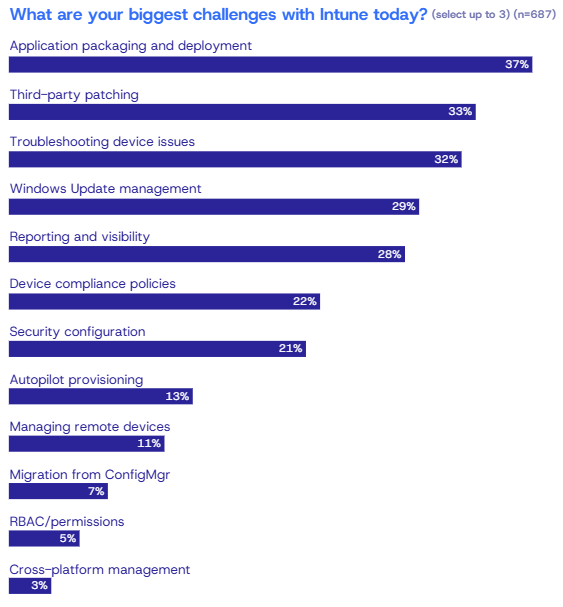
The underlying data helps explain why these challenges continue to surface. Nearly half of respondents said they still package Win32 applications manually, making it the most common application deployment approach by a wide margin. Automated packaging tools and native Intune-only methods were significantly less common.
Third-party patching presents a similar story. Although many organizations have introduced some level of automation, patching maturity remains uneven. Less than half of respondents reported fully automated third-party patching, while many others described their environments as only partially automated.
Taken together, these findings illustrate how application lifecycle management is a substantial administrative burden. As software portfolios grow and security threats evolve, manual packaging and patching processes become increasingly difficult to sustain. Organizations may be modernizing endpoint management, but application management remains one of the biggest obstacles to improving efficiency.
Conclusion
The State of Intune in 2026 reveals that IT teams are managing Intune with significant manual effort, yet they are satisfied with the platform. This gap between satisfaction and workload is perhaps the survey’s most important finding. The takeaway is that Intune’s value is not in question. The real opportunity lies in helping IT teams reduce manual work, improve automation, and operate more efficiently. Organizations that can do this will be better positioned to focus on strategic initiatives instead of day-to-day firefighting.
Recast helps IT organizations operate more effectively alongside Microsoft Intune and ConfigMgr. Teams around the world enhance Intune and ConfigMgr with Recast solutions, including:
- Application Workspace for application management
- Right Click Tools, with modules for Patching, Insights, and Privileged Access, for critical aspects of endpoint management